Why Your To-Do List Doesn’t Work (And What to Use Instead)
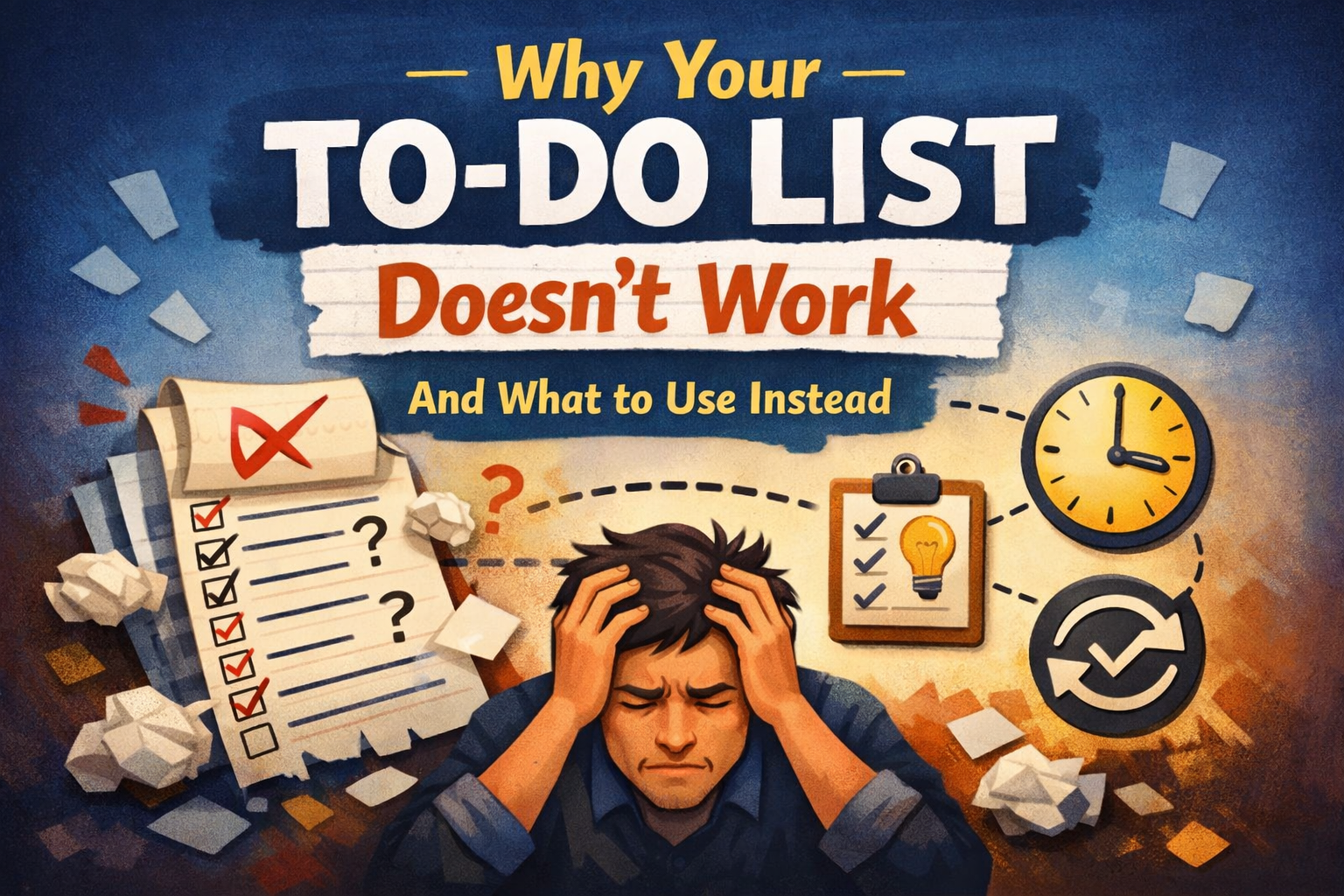
A to-do list feels productive because it gives your brain a quick “I’m on top of it” hit.
But for most people, the list doesn’t fail because they’re lazy.
It fails because a plain list is missing the 3 things real life requires:
- time
- context
- review
A to-do list is just inventory. Your life is a schedule.
Below is why the classic list breaks down, and what to use instead if you want consistent execution.
1) A to-do list ignores time (the real constraint)
A list treats every task like it has the same weight.
But your day has fixed limits:
- energy (you’re not equally sharp all day)
- time blocks (meetings, family, commute)
- deadlines (some tasks expire)
So the list becomes unrealistic fast.
You end up with:
- 40 tasks staring at you
- no clue what actually fits today
- constant shuffling and guilt
What to use instead: a daily plan that forces time reality.
Even if you don’t do strict time blocking, you need:
- a small “Today” set (3–8 tasks)
- rough time estimates
- a clear start task (first action)
2) A list doesn’t tell you what “done” means
Many tasks on a to-do list are not tasks. They’re projects.
Examples:
- “Build landing page”
- “Improve marketing”
- “Fix website”
- “Get fit”
These are outcomes. Not next actions.
When you don’t define the next action, you procrastinate—not because you’re lazy, but because your brain can’t start.
What to use instead: convert every project into a next action.
A task should be something you can do in one session:
- “Write landing page headline options (20 minutes)”
- “Collect 5 competitor hero sections (30 minutes)”
- “Fix mobile menu padding (15 minutes)”
- “Book gym session for Tuesday (5 minutes)”
If the task still feels heavy, it’s still a project. Split it again.
3) A to-do list has no context, so you repeat thinking
A list is flat. Life isn’t.
When you write “Email John”, you’re missing:
- what the email is about
- what you decided last time
- the link, attachment, or notes you need
- what “good enough” looks like
So you re-think the task every time you see it.
That mental reload cost is why lists feel exhausting.
What to use instead: attach context to the task.
At minimum, your system should let you store:
- notes
- links
- quick comments to future you
- files/screenshots if needed
So when you return to a task, you can resume instead of restart.
4) A list doesn’t protect focus (it invites switching)
A long list encourages random picking:
- “I’ll just do something easy.”
- “I’ll do a bunch of quick tasks.”
- “I’ll bounce between things.”
You stay busy, but you don’t move the needle.
Switching costs more than people realize:
- it drains attention
- creates a feeling of chaos
- increases mistakes
- kills deep work
What to use instead: commit to a sequence.
Not a perfect schedule—just a simple order like:
- one important task first
- two medium tasks
- a few small tasks last
Execution improves when the day has shape.
5) A to-do list doesn’t include a feedback loop
This is the biggest problem.
Most lists are used like this:
- write tasks
- try to do them
- move leftovers to tomorrow
- repeat
No learning happens.
You never ask:
- Why didn’t I do this?
- Was it unrealistic?
- Was it unclear?
- Did I overload the day?
- Am I avoiding it?
- Did something else matter more?
Without review, you can’t improve your planning.
What to use instead: a daily + weekly review loop.
A simple review can be 3 minutes:
- What did I actually do today?
- What mattered?
- What should change tomorrow?
And weekly:
- What worked this week?
- What keeps slipping?
- What should I stop doing?
That’s how productivity compounds.
So what should you use instead of a to-do list?
Not “another list app.”
You want a plan + context + review system.
Here’s a simple structure that works for most people:
Step 1: Capture everything (inbox)
Dump tasks and ideas in one place so your brain relaxes.
Step 2: Plan the day (small list)
Pick a realistic set for today:
- 1 important task
- 2 medium tasks
- 3 small tasks
(Adjust the numbers to your life.)
Step 3: Tie tasks to time (even loosely)
Add rough durations and place tasks around your day.
Step 4: Keep context next to tasks
Notes, links, quick decisions, comments.
Step 5: Review daily + weekly
So you learn and stop repeating the same mistakes.
Why date-based planning beats list-based planning
A big reason to-do lists fail is they’re not tied to how you live.
You live in days.
You remember life as:
- “What did I do Monday?”
- “What happened last week?”
- “When did this start going wrong?”
- “What did I decide back then?”
A date-based system matches your brain’s timeline.
When tasks, notes, and decisions are connected to days:
- planning becomes more realistic
- context is automatic
- review becomes easy
- you build “personal history” you can learn from
Example: a “better than a to-do list” daily setup
Today (3–8 tasks max):
- Write the first draft of the homepage hero (45m)
- Fix mobile nav spacing (15m)
- Reply to 3 client messages (20m)
- Book dentist appointment (5m)
Notes attached:
- hero examples link
- copy ideas
- decision: “no jargon”
- screenshot of the mobile issue
End of day review (2 minutes):
- Done: hero draft, nav fix
- Not done: dentist (no time)
- Change tomorrow: do appointment first (quick win)
This is what makes execution feel calm.
Where SelfManager.ai fits (if you want one place for everything)
SelfManager.ai is built around the idea that your day is the truth.
Instead of managing life as a flat list, you manage it as a timeline:
- tasks + time awareness
- notes and comments stored with the day
- easy daily/weekly/monthly review because everything is already organized by date
- a “home base” approach so you don’t spread context across 5 tools
If a normal to-do list keeps failing you, the upgrade isn’t “more motivation.”
It’s a better system.
A simple challenge (try this tomorrow)
Tomorrow morning:
- pick 3 tasks only
- estimate time for each
- write the first action for each
- at the end of the day, write 2 lines:
- what mattered today
- what you’ll change tomorrow
Do that for 7 days.
Your to-do list will start feeling obsolete.

AI Powered Task Manager
Plan smarter, execute faster, achieve more
Create tasks in seconds, generate AI-powered plans, and review progress with intelligent summaries. Perfect for individuals and teams who want to stay organized without complexity.
Get started with your preferred account